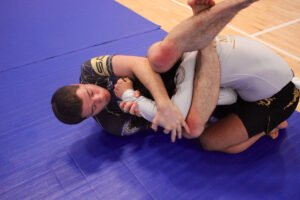
Jiu Jitsu is the ultimate physical strategy game with one central goal: submit your opponent. Within the vast world of grappling there are many ways to accomplish this goal. These are broken down into two categories, Positional Systems and Submission Systems.
9 Positional Systems
- Standing position/takedowns
- Loose guard passing
- Tight guard passing
- Top pinning
- Guard retention
- Open guard
- Closed guard
- Half guard
- Scrimmage wrestling
6 Submission Systems
- The Back
- Front Headlock
- Ashi Garami (leg locks)
- Juji Gatame (arm bars)
- Kimura
- Triangle
Positional Systems
There are 9 positional systems of the game which can be divided into two halves- the top game and the bottom game. Each player will have a general preference for either top or bottom positions. Though it should be the student’s long term goal to become proficient in all areas of the game.
Our beginner’s curriculum typically starts with surviving and escaping from the worst positions in the game. When you first start out, you won’t be able to have a preference for a particular position. Developing survival skills is the key to developing confidence and building your game.
Top Positions
Standing Takedowns – The first goal is to be able to take your opponent down to the floor. Breaking your opponents posture, base and stance allows you to get opportunities to wrap their legs up and get them down to the mat.
Loose Passing – once your opponent is down to the mat, you next need to get past their legs. The legs are the most powerful and dangerous part of a human being. Grappling from the bottom, The various guards of the sport all involve using your legs to control your opponent. You want to avoid getting entangled in these guards. Loose passing is all about utilizing speed and movement to misdirect and get around your opponents legs. This style is generally suited to smaller, faster players.
Tight Passing – You can use control based methods to pass your opponents guard and get around their legs. Utilizing wedges to limit their movement, allowing you to shut down their attempts at guard play, pinning their head and shoulders to the mat and smashing past their legs are all highly effective strategies for passing an opponent’s guard. This style is generally suited to larger and slower players.
Pins – Once past the legs, The top player has two options- work towards limb isolation and submission, or move through the hierarchy of pins from side control/north south to knee on belly, mount and the back. Each step up the hierarchy offers better and better submission opportunities.
Bottom Positions
Bottom Pins – Unfortunately for beginners, this is where they spend most of their time. More skilled opponents will take you down, get around your legs and look to make your life miserable. Your main focus in the first 6-12 months of training is to survive this pressure without conceding a submission. The key to survival is to not panic, stay calm and look to use various body movements to get your legs back between you and your opponent. Once you get your legs back between you and your opponent, you then enter the realm of guard retention.
Guard Retention – Guard retention is all about shutting down your opponents attempts at getting around your legs. This system is all about understanding how to move when stuck flat on your back, shutting down your opponents movement option as you move towards the various guards of the sport.
The Guards
The central feature of any guard is to form enough control over your opponent’s body using your limbs and surface area to tie them up, gaining control and influence. You can then look to use your control and influence to move up the hierarchy to better forms of control via positional advances and submission attempts.
Open Guard – Open guard has many variations and is centered around the idea of inside control. Both top and bottom players are always looking to divide their opponents body by bringing one or both of their legs in between their opponents. This battle for centerline control is a prime directive in the sport. Controlling the centerline leads to submission opportunities via limb isolation and positional advancement.
Closed Guard – Closed guard is centered around the idea of outside control. By wrapping both of your legs around your opponent’s body, you limit their movement by controlling their posture and balance. The two main goals from closed guard are to sweep or submit your opponent. To accomplish these goals you must utilize kazushi (off balancing). This forces opponents to overextend limbs to maintain base, offering submission opportunities. If your opponents choose not to or cannot post their limbs out for base, this gives us an opportunity to sweep opponents over allowing us to take top position.
Half Guard – Half guard is paradoxically a good position for both the top and bottom players. The battle is all about who is in control of the bottom players head and shoulders. If the top player manages to control and pin the bottom player’s head and shoulders, It is a great tight passing position. Whereas if the bottom player is free to move, they can kazushi (off balance), steal inside control and use it to advance to better forms of control. Bottom half guard offers high percentage sweeps/reversals and offers access to many submission systems.
Scrimmage wrestling – scrimmage wrestling is all about the scramble for top position when in the areas of the game between these main positions. There is always a battle for top position as it allows the top player to take control and force the direction of the play. In mixed martial arts (though not submission grappling) the top position offers great opportunities for strikes against the bottom player. With the addition of gravity on the top players side and the movement restriction debilitating the bottom player, the top position is highly prized. When in doubt – get on top.
Submission Systems
There are 6 main submission systems that we use. Within each system there are many sub-systems for that submission, bringing diversity to the game.
The Back – the human body is not designed to deal with threats from the rear. This position is the best in the sport offering access to the highest percentage submission in the game- the rear strangle.
Front Headlock – The most readily available submission system- front headlock offers expedient and highly effective strangles such as various types of guillotine and Kata Gatame (arm in strangles).
Leg Locks (Ashi Garami) – The latest evolution in the grappling arts is the addition of systematic leg locks using ashi garami. John was made famous for his students’ use of this devastating system. Offering some of the most dangerous joint locks in the game – the inside heel hook, the outside heel hook, knee bars and toe holds. Ashi garami is one of the most effective ways to attack as your legs are very difficult to hide from your opponent.
Arm Locks (Juji Gatame) – Juji gatame is a more traditional system that offers powerful arm locks that can be used in two ways – speed based methods, utilizing the element of surprise, or control based methods which gradually restrict your opponents movement options until submission. Both are highly effective strategies which work extremely well when used in conjunction with other threats.
Kimura – both a submission and a link to other systems , the Kimura is a highly effective arm lock which offers excellent control over an isolated arm. The kimura system links very well with upper body and rear attacks, making it a great pathway between systems.
The Triangle (Sankaku) – The Triangle uses the power of your legs to strangle your opponent. The alignment of the strongest part of your body (your legs) against a weaker part of your opponents body (one arm and their neck) is the perfect expression of the power of Jiu Jitsu – even if you are weaker and smaller than your opponents, you can align your body in such a way to negate this and overcome size and strength discrepancies.
With time and training, you can develop the ability to link various submission and positional systems, unlocking endless options for creativity. As you build knowledge in specific areas of the game, you can start outwitting your opponents by putting them into dilemmas, funneling them into your traps.
It is this knowledge based, strategic element of the sport which draws parallels with chess.